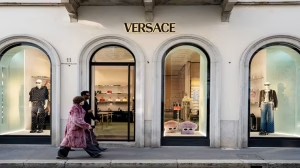
Prada just made one of the boldest moves in luxury fashion this decade: it has officially acquired Versace from Capri Holdings for about €1.3 billion (≈ $1.5 billion).livemint
This isn’t a random trophy buy. It’s a very deliberate bet on brand equity, awareness and portfolio power.
Versace, founded in 1978 by Gianni Versace in Milan, is one of the most recognisable luxury brands in the world – loud, glamorous, instantly identifiable. For years, Prada has “quietly courted” the brand, with conversations happening even during the COVID period and before Capri’s attempted sale of Versace to Tapestry. When that Tapestry deal collapsed over antitrust concerns, Prada moved fast to close.
A few strategic angles that stand out:
- Portfolio strategy: Versace now sits alongside Prada and Miu Miu, giving the group three distinct but powerful positions in the luxury pyramid – minimalist intellectual luxury (Prada), playful and youth-focused (Miu Miu), and bold, high-glam statement dressing (Versace).livemint
- Brand awareness as an asset: Lorenzo Bertelli (who will become executive chairman of Versace) was clear that Versace ticked two boxes – financially not “too risky” and among the top brands globally in awareness. In other words: this is a marketing asset as much as a balance-sheet one.livemint
- Timing and leadership shift: Just weeks before the deal was announced, Donatella Versace stepped down as creative chief after almost three decades, with Dario Vitale (ex–design director at Miu Miu) stepping in. That makes integration smoother and opens the door for closer creative synergy within the Prada group.livemint
For business and marketing leaders, this deal underlines a few big themes:
- In saturated, mature categories, buying attention and brand equity can be more powerful than endlessly chasing incremental growth in-house.
- Regulation shapes strategy: the failed Tapestry–Capri deal due to antitrust scrutiny effectively created the opening Prada needed.
- The real post-deal battle won’t just be about synergies and cost structures, but about how well Prada can leverage Versace’s global awareness to drive growth without diluting its iconic, theatrical identity.
It’s a reminder that in luxury, the ultimate “asset” isn’t a factory, store network, or supply chain – it’s the story and status the brand holds in culture.
Deal numbers and key data in a table
| Item | Detail |
|---|---|
| Acquirer | Prada |
| Target brand | Versace |
| Seller | Capri Holdings (U.S.-based) |
| Purchase price (approx.) | €1.3 billion |
| Purchase price (approx. USD) | $1.5 billion |
| Implied FX rate given | €1 = $1.16 (stated as $1 = 0.8613 euros) |
| Original planned buyer (failed deal) | Tapestry |
| Reason original Capri–Tapestry deal failed | Antitrust challenge |
| Deal announcement / completion context | Completed after definitive agreement signed in April |
| Versace founding year | 1978 |
| Versace founding city | Milan |
| Versace founder | Gianni Versace |
| Gianni Versace’s death | Shot dead in Miami in 1997 |
| New role announced | Lorenzo Bertelli to become executive chairman of Versace |
| Lorenzo Bertelli | Son of Prada owners Miuccia Prada & Patrizio Bertelli |
| Versace creative director change | Donatella Versace stepped down in March |
| New creative lead | Dario Vitale (formerly design director at Miu Miu) |
| Key condition 1 for acquisition | Not too risky financially |
| Key condition 2 for acquisition | High brand awareness globally |
| Statement on deal history | Contacts during COVID; talks before Capri–Tapestry sale; deal in the works “for a long time” |
Also Read: AI Se Paise Kaise Kamaye: 5 Practical Ways Indians Are Earning From AI in 2025